Devanagari

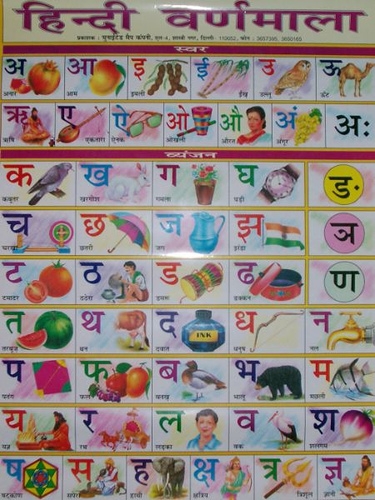
Although the film will be shot in Gujarat, Shashwati does all the interviews in Hindi, and in the future we are likely to be visiting North India on a semi-annual basis, so I figured I ought to start studying Hindi. I made an initial stab at it during our last trip, but didn’t get very far. This time I hired a private tutor and really buckled down. Because I’m only going to class once a week, I don’t expect to get beyond the basics, but I’m already pleased as punch that I can decipher the Devanagari script, and I’m even learning how to bargain with rickshaw drivers. I still read like a little child, spelling things out letter-by-letter, and not always getting things right, but it is great fun.
hindialphax

I’m using Rupert Snell’s Teach Yourself Hindi, which comes with CDs I’ve ripped to my iPod and listen to on the train. But for learning the script I found his smaller and more focused volume, Teach Yourself Beginner’s Hindi Script to be invaluable. I love that he has many examples of actual roadside signs that you can practice on.

One of the cool things about the Devanagari script is that it is ordered phonologically. The sounds are listed in order of where in the mouth the sound is produced: gutturals (produced in the throat) first, and labials (produced by the lips) last, with a steady progression in between. (See here.) I am curious when this ordering became standard. I know that the study of language and grammar has ancient roots in India, such as the famous fifth century scholar, Pāṇini, but the Devanagari script is actually much more recent, dating from the twelfth century. Some of its antecedents were the Siddham script, the Gupta script from the fourth to the eighth centuries and, ultimately, the 5th century BCE Brahmi. (I really like the way Brahmi looks!) Looking at these scripts I see that many of them listed in the same order as the Devanagari script, but it isn’t clear if this is a modern convention or if there are historical reasons for listing them this way.

Perhaps some of my erudite readers have more insight into this?

PS: It is very annoying that Firefox for the mac doesn’t properly display Devanagari. This seems to be a known bug, but nothing has been done about it…

UPDATE: In the comments over at Amardeep’s blog, Srikanth pointed out this article:

Recalling sage Panini’s 2,000-year-old contribution to acoustics, the former Vice-Chancellor of Hyderabad University, B.S. Ramakrishna, on Thursday said the sage’s well-researched arrangement of the alphabet of Devanagiri script was a unique effort.

Inaugurating a national workshop on “Acoustic analysis of speech” here, Prof. Ramakrishna said the scientific arrangement of alphabets of Devanagiri script was in accordance with the pronunciation of sounds. “This is not found in any other language in the world,” Prof. Ramakrishna said.

Now, as I pointed out above, Pāṇini died a few centuries before Devanagiri came into being, but I suspect that this is still accurate – that the ordering is based on his research. However, he probably applied it to a different script. Perhaps Gupta?

{, }

If you enjoyed this post, please consider to leave a comment or subscribe to the feed and get future articles delivered to your feed reader.

Comments

way in which Sanskrit letters are arranged in the varṇamālā has a phonological significance. A subset: UnvoicedVoiced NasalGutturalkkhggh ṅPalatalcchjjhñRetroflex ṭṭhḍḍhṇ DentaltthddhnLabialpphbbh m Aspirated Aspirated In an interesting post , Dr. Kerim Friedman says: The sounds are listed in order of where in the mouth the sound is produced: gutturals (produced in the throat) first, and labials (produced by the lips) last, with a steady progression in between[

Hi, dropped in via Amardeep Singh’s blog.

One of the cool things about the Devanagari script is that it is ordered phonologically.

As given above, Devanagari is a script, while what you mention as phonologically arranged is the Sanskrit alphabet.

It is only recently (after Europeans took up Sanskrit study) that Devanagari became the standard script for Sanskrit. It used to be written in the script of the regional language (Bengali in Bengal, Telugu in Andhra or in Grantha in the Tamil region). So, Indian languages (except Tamil, an ancient language itself) have the same alphabet as Sanskrit, with some additions (such as the short E and O vowel sounds in the southern languages).

I am not sure when exactly the phonological arrangement came into vogue, but the first book of the Taittiriya Upanisad is called Seeksha-valli (seeksha – ‘phonetics’). See Lesson 2 of this book here.

Srikanth: What do you mean by your distinction between “script” and “alphabet”? If Sanskrit didn’t have its own writing system, how can it have an alphabet? We can write Sanscrit in the latin alphabet, with a few modifications, but that doesn’t mean that Latin has the same alphabet as Sanskrit. Now, it is possible that the system of phonological ordering preceeded writing, but I haven’t yet found any evidence of this.

Well, ñ is a letter in the Latin script, but not part of the English alphabet. Similarly there are Devanagari letters which aren’t used in Sanskrit. One could perhaps speak of a single Sanskrit alphabet, in the sense of a list of distinctive characters representing particular phonemes, cutting across the various related scripts in which the language has been written.

It’s my understanding that Pāṇini lived before any writing system was introduced to India* (though there is some uncertainty over his dates, so this is open to question).

From Coulson’s Sanskrit: An Introduction to the Classical Language (AKA Teach Yourself Sanskrit):

The grammar of Pāṇini, the Aṣṭādhyāyī, usually attributed to the fourth century BC, is evidently the culmination of a long and sophisticated grammatical tradition, though the perfection of his own work caused that of his predecessors to vanish. In less than 4000 sūtras, or brief aphorisms (supplemented on points of detail by the grammarian Kātyāyana) he analyses the whole morphology and phonology of Sanskrit. He anticipates much of the methodology of modern formal grammar: his grammar is generative and in some respects transformational. It cannot, however, be compared very directly with modern formal grammars, since its form is geared to the needs of oral transmission, and Pāṇini could not avail himself of the mathematical symbols and typographical conventions of the written page. The work was so brief that it could be recited from beginning to end in a couple of hours.

*Obviously the Harappan script, if it is a script, predated this, but was long extinct by this point.

Thanks Tim.

[...] I recently wrote a post on my other blog pondering how the Devanagari alphabet came to be ordered in such a rational way. So I was excited to read about this exciting archaeological find, described in the New York Times as “the oldest reliably dated example of an abecedary – the letters of the alphabet written out in their traditional sequence.” [...]

Hi Kerim,

An update!

My friend, Sunil (who, btw, writes an excellent blog Balancing Life) was kind enough to take the question to his Sanskrit professor at University of Washington, Dr Richard Saloman.

This is what the professor had to say:

This is an interesting, but not simple question. The “ka-kha-ga-gha” order, or better, the “varna-samaamnaaya,”

is hard to date precisely. Panini (who himself is hard to date) doesn’t use it as such, but his own technically devised special ordering, the Siva-suutras, is usually understood to presuppose it.

It actually occurs as such only in relatively late technical texts such as Praatisaakhyas. All of this suggests that the varna-samaamnaaya ordering principle goes back well into the BC period, but no more specific or definite answer can be meaningfully given.

The other question is whether Panini’s system presupposes or requires writing at all. This has been quite controversial, but most scholars nowadays would say no; it can be, and probably is, a purely oral/mnemonic system. (Some European “armchair” scholars of earlier decades thought this was impossible, but direct acquaintance with Indian pedagogy and oral traditions have convinced later generations of western scholars that it is quite possible.)

How does one explain the demonisation of Panini in Hindu Mythological litt ?Panini is shown as a villian.Was he a Buddhist or Jain or did he belong to Nyaya/Ajivika or some other heterodox sect of those days?I strongly feel that he was not a’hindu’.

That’s a question that goes way out of my range. I’ve barely learned the Devanagari alphabet! Debates over the demonization of Panini are a bit over my head…

Sorry, the comment form is closed at this time.